Description
HISTORY
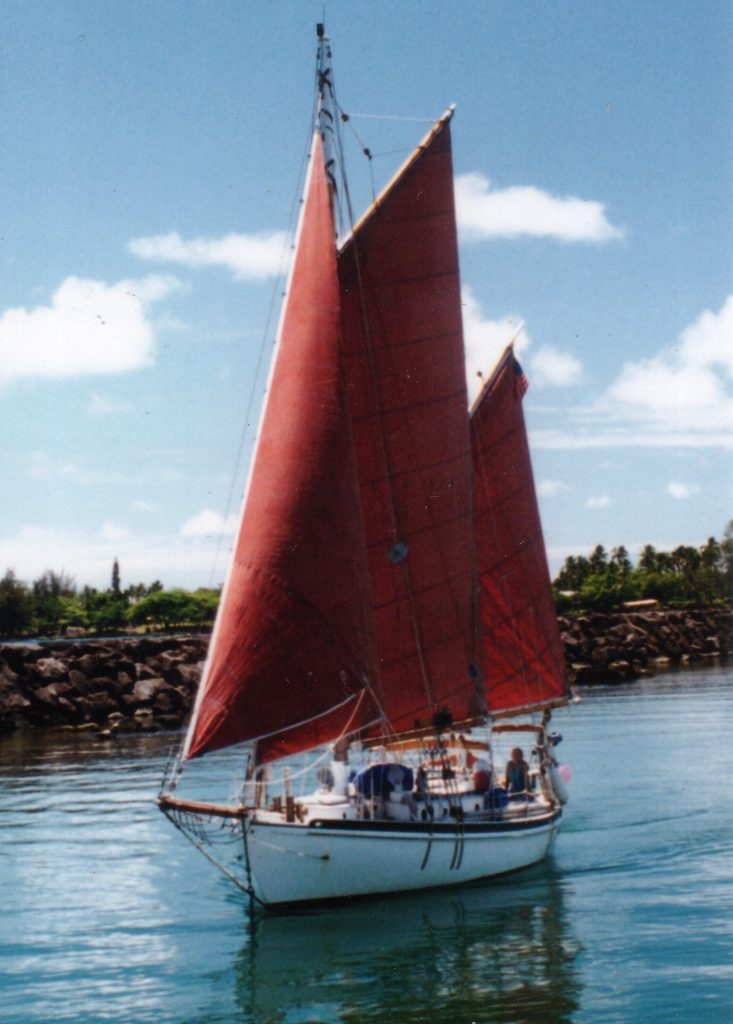
PILAR was a dream we built for a home, a holistic way of life, and a return to the Solomon Islands where Bill Pool fought as a Marine during WWII. She was named for the gypsy woman in Hemingway’s book, For Whom The Bell Tolls. PILAR is a dedicated mixture of sturdy substance, an idealistic endeavor, and romance.Bill had long loved all of William Atkin’s boats, but INGRID was his heart’s desire. When we began building PILAR he said, “It’s more important that we do it TOGETHER than how well it’s done.” ‘Together’ was the magic ingredient.
PILAR is Bluewater Boat’s Ingrid 38. Her bare hull was delivered to us on May 1st of 1975. The decision to buy a fiberglass hull rather than build with wood was a practical one—Bill had just turned 48. The decision proved wise as it took us NINE years to complete the deck, cabin, and interior, before we launched her on the 18th of August 1984. PILAR was christened with South Pacific saltwater from Tahiti, a gift kept frozen until needed.
Seven more years were still needed to finish building the cockpit, forehouse, spars, and splice her standing & running rig before we would cast off our dock lines to go cruising. PILAR was STILL not finished, but on that joyous day, May 16, 1991, at 1600 hours the log book noted it was exactly 16 years and 16 days since bare hull #38 arrived in our back yard.
Our pleasure in crafting custom-made fittings & woodworking details had extended the building years into sixteen years (not the three or four we’d imagined), reducing our chronological years for cruising… but it was worth it. The satisfaction of working so well together strengthened our relationship, and while there was an inevitable loss of formerly easy agility, it did not diminish the fullness of our short sailing life.
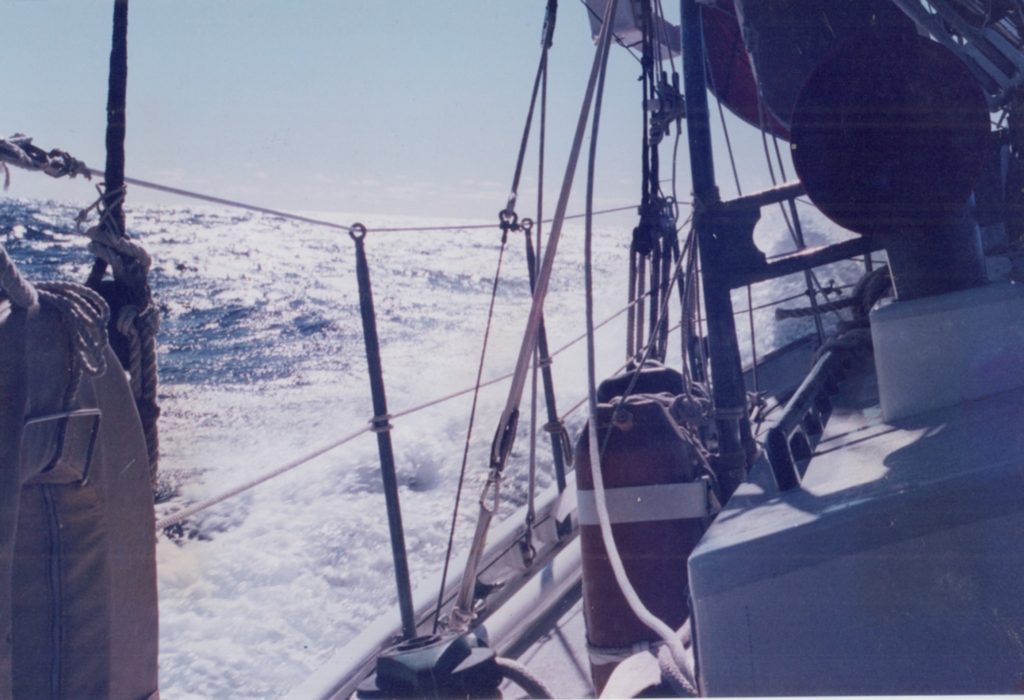
PILAR spent her first two years cruising the Sea of Cortez, Baja California, before setting sail for the South Pacific (48 days to Mangareva, Gambiers), then Tahiti before turning northward, stopping at the remote atoll Caroline Island (Kiribati / ‘The Wreck of ORACLE’) en route to Hawaii. We spent a year in Hawaii, recovering from witnessing our friend’s boat (and French rescue tug, AITO) wrecked on the reef.
November 15, 1995, PILAR resumed her quest of reaching the Solomon Islands. Sailing slowly, she then passed through island groups within Kiribati and the Federated States of Micronesia until July 10, 1996, when PILAR dropped her anchor in Honiara, Guadalcanal—fifty-three years after Bill stepped ashore to fight the Japanese.
With Bill’s dream fulfilled, PILAR sailed to Australia for refitting: new standing rigging (galvanized wire, spliced, parceled & served), an enlarged stern aperture for a larger propeller, bottom paint stripped & small blisters sealed with epoxy, six coats of copper antifouling, and three coats of topside white urethane. It was a welcomed two years of immersion in the Maryborough, Queensland community of Aussie boat builders and their famous barbecues.
September 15th, 1998, our last legal day in Australia, Bill observed that the date was also the fifty-fourth year since he’d landed on Peleliu, Palau. Undoubtedly, the worst fighting experience of Bill’s WWII years. Returning to Peleliu, March 25, 1999, provided rewarding closure to our sailing mission.
Uncertain about what was next, PILAR brought us to the Philippines. For Bill (73), building small boats was a meaningful plan, while I (51) looked forward to an artist’s studio… so we rented space ashore for both projects, and remained aboard our ‘forever’ home, PILAR.
Bill died in 2009, age 83. I’ve continued to live aboard and maintain her, but the time has come for other hands to appreciate PILAR. Though not modern—no hot water, pressure water, or extensive electronics—her simplified ways reflect craftsmanship, ‘sturdy substance’, and aesthetic beauty.
Recently, during a discussion in Cruiser’s Forum about buying a boat, ISLAND TIME observed:
“…maybe the most important consideration in the long run, the boat has to sing to you that it is yours and will be yours for years to come. Maybe time will come to part with it but as long as you have it, it should be the best, most lovely looking, most comfortable for YOU, the skipper, and no one else. Then all of the problems, faults and blemishes will be fixed much easier and with more enthusiasm than doing it with the boat you just tolerate or worse—indifferent to.”
CONSTRUCTION
HULL
–Fiberglass, all woven roving, no mat: 1-1/2” (38.1 mm) at keel, 3/8” (9.5 mm) at bulwark
–1″ Styrofoam insulation beneath Port Orford Cedar ceilingsLAID DECK
–Composite thickness 1-1/2” (3.81 cm)
–Port Orford Cedar strakes 1-1/8” /(28.5 mm), bronze fastened
–Brunzeel plywood subdeck 3/8” (9.5 mm), long-scarfed over deck beams
–Douglas Fir deck beams, fastened on 10” (25.4 cm) centers
–Sidedecks are wide 2’8” (81.28 cm) the full length of main cabin 13’8” (4.16 m)
–Working deck width at main mast is 9’2″ (2.79 m) before tapering to bow
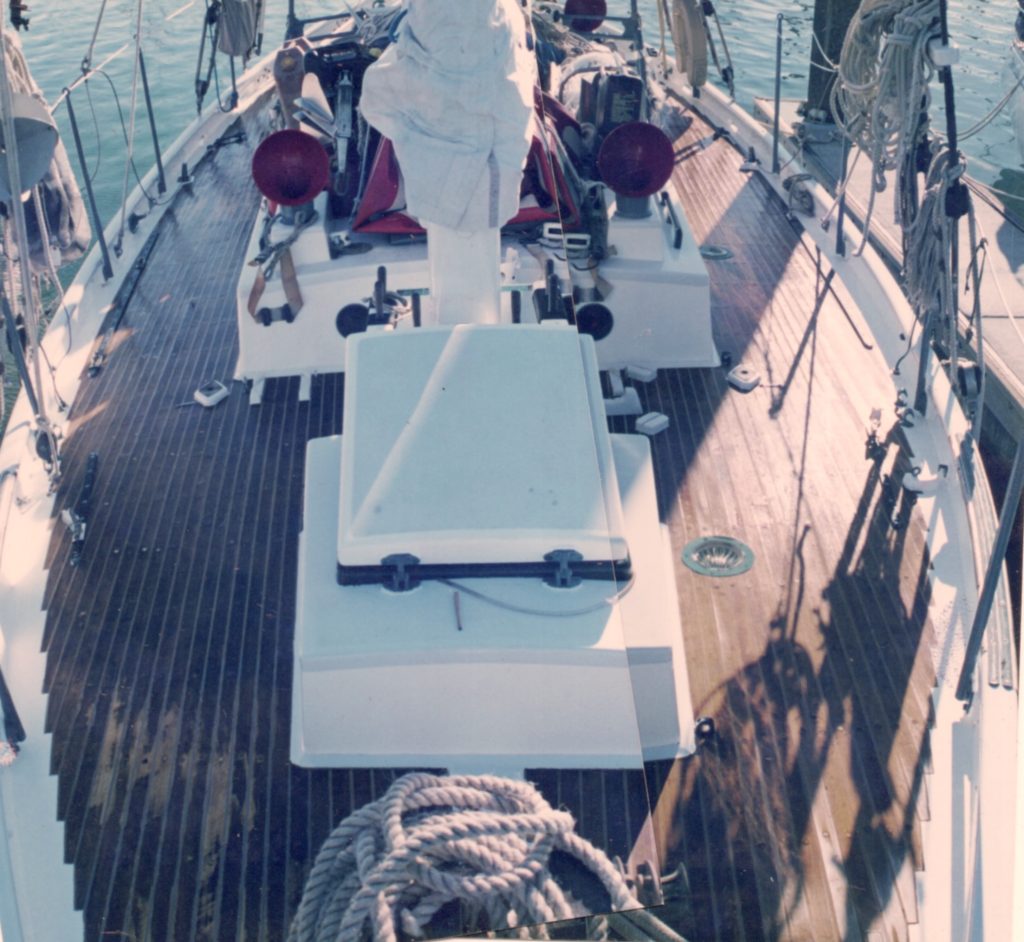
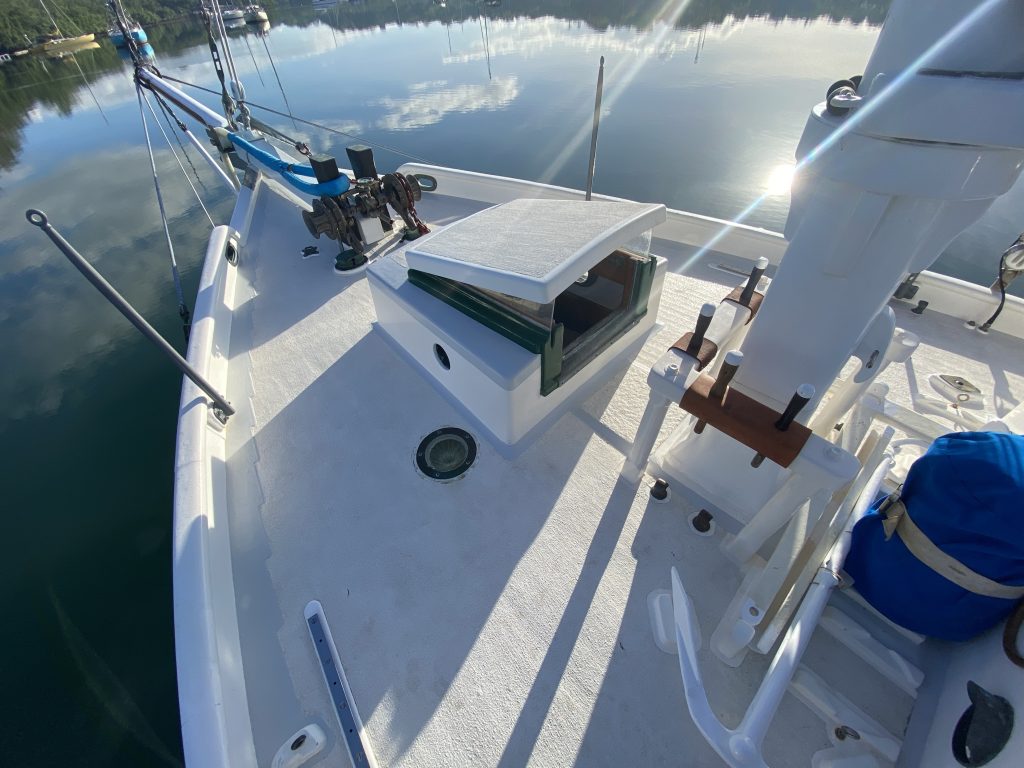
–1998 Cedar deck was painted white with TREADGRIP (Australian water-based nonskid) for comfort on bare feet. Renewed routinely it remains in solid condition
–Kingplank, covering boards, and railcaps are air-dried Honduras Mahogany 1-1/2” (4cm)CABIN & FOREHOUSE
–Cabin sides of the two houses are Port Orford Cedar 2” (5.08 cm), set on sills
–Cabin tops are 2 layers of 3/8” (9.5 mm) Brunzeel plywood sheathed tight with Yellowjacket screen impregnated with water-based pipe sealant
–Companionway hatch on forehouse faces aft to provide exhaust ventilation during sailing or bad weather
–Three Teak Dorade boxes with cowl ventilators 8” (20.3 cm) mounted on main housetop
–Eight bronze Perko portholes 6” (15.2 cm) in main house sides, two 5” (12.7 cm) at forward end of house, two 4” (10.1 cm) in the ForehouseMASTS & RIGGING – Gaff Ketch
–Masts are laminated Sitka Spruce, almost solid but for an internal PVC pipe for wiring
–Booms & bowsprit are old-growth Douglas Fir
–Bowsprit OA 13’1” (3.98 m) uses a traveling ring with its own stay to haul headsails out-and-back, from PILAR’s stem to the end of the bowsprit, a distance of 6’8″ (2.03 m)
–Gaffs are air-dried Sitka Spruce
–Standing & running rigging shrouds are Australian galvanized 7×7 wire, spliced, parceled & served above spray reach (1997)
—2023 new Stainless wire for gaff spans, whisker stays, running backstays, coated lifelines. Galvanized shrouds still sound so we completed service that had been left bare, then painted the entire lengths light grey to ensure longjevity.
–Deadeyes are Black Locust; Blocks are Lignum Vitae from A. Dauphinee & Sons
–Working Sails main, mizzen, jib, staysail & top’sl, are Tanbark. Trysail & stormsail are white. Spinnaker is the usual riot of color.RUDDER
–Air-dried Honduras Mahogany 2-7/8” (7.3 cm), bronze through-bolted
–Port Townsend Foundry bronze pintle & gudgeons
–White Oak tiller, grown, not laminated 7’3” x 2-7/8” (2.2 m x 7.3 cm)COCKPIT & LAZARETTE
–SESTREL MAJOR compass mounted on bridge deck kingplank, in line with mizzen mast
–Beneath bridge deck is an Edson emergency bilge pump 18 gpm (68.1 lpm)
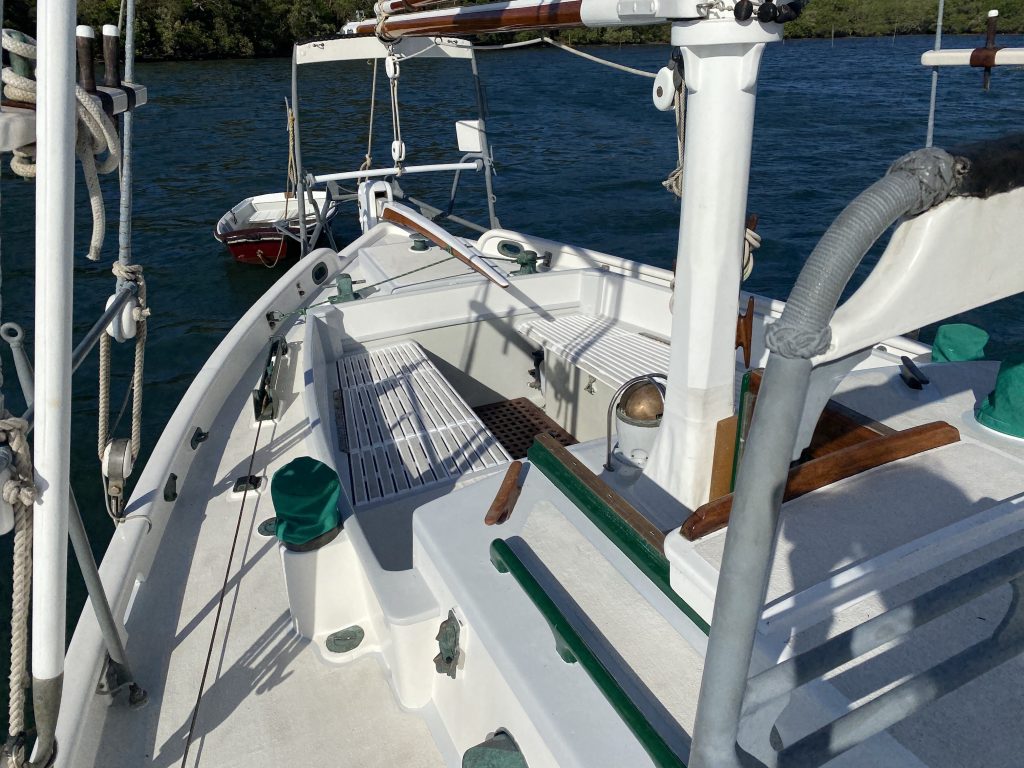
–Cockpit seats 6’2” (1.87 m) are Port Orford Cedar slats, raised for water drainage. Beneath, plywood lockers sheathed with epoxied Dynel cloth
–Teak floor grate
–Lazarette is large enough to crouch inside for maintenance
–VITUS heat exchanger mounted inside
–Vintage bronze ventilator 3” shaft w/4” cap on hatch cover lifts UP for adjustable positionsENGINE
–SABB 2GZ, 22hp, Norwegian fishing boat engine
–Two-blade propeller, controllable pitch forward/reverse (not feathering)
–Freshwater keel cooled
–BALMAR alternator
–Two RACOR fuel filter/water separators
–FUEL TANKS: (2) Monel 13-1/2 gal (51.1 ltrs) = 27 gal (102.2 ltrs) totalENGINE ROOM
–Access from cockpit via hatch beneath Teak grate
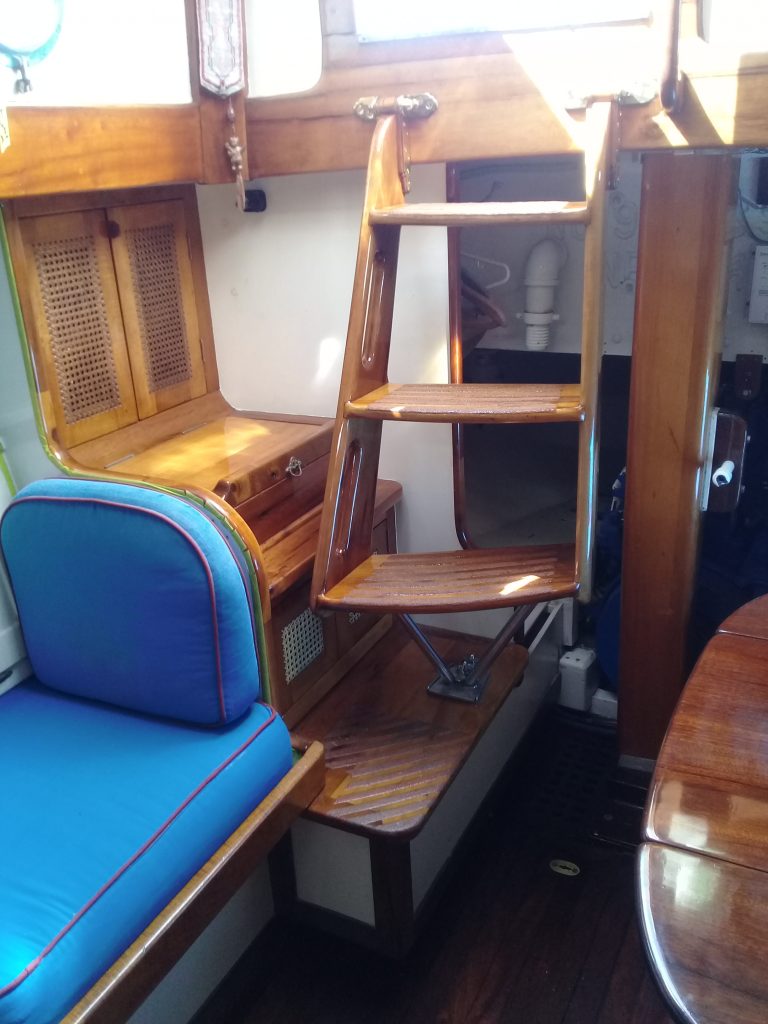
–Access from below on both sides of the Mizzen mast. Starboard features a fold-down seat for servicing when the ladder is swung up and latched. Portside features a removable cabinet/seat-back that swings out for full maintenance access and a second emergency bilge pumpBELOW DECK
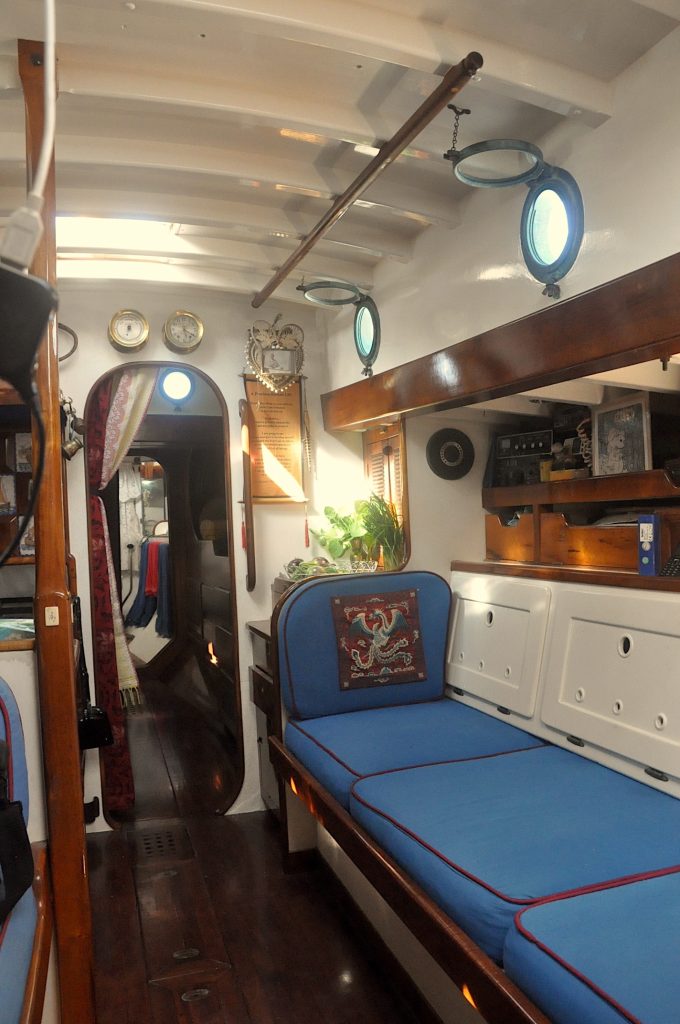
–The Main Cabin consists of the saloon and midship galley, separated from the sleeping cabin by a full-width bulkhead
–Headroom under beams is 6’1” (185.4 cm)
–Numerous strategic handholds are located throughout the interior
–Furniture is predominately air-dried Oregon Myrtlewood
–Cabinsole is air-dried Honduras Mahogany
–Beneath cabinsole are 3 separate integral fiberglass water tanks: 25 gal (94.6 ltrs), 32 gal (121.1 ltrs), and 13 gal (49.2 ltrs)
–Ceilings and sleeping cabin paneling are Port Orford Cedar
–All locker doors are hand-caned for ventilation; secondary bulkheads are drilled for superior air circulation
–The Forehouse contains the head, bosun’s lockers, and chain lockerSTARBOARD-TO-PORT WALK-THROUGH
Starboard:
–The Companionway Ladder: Hand-crafted Myrtlewood featuring four non-skid steps. Three steps follow a Constant-Width Curve, with the lid of a battery box serving as the fourth step to the cabinsole
–Behind the ladder is a foul weather locker draining into a floor grate over the bilge pump
–Behind (outboard) the foul weather closet is a custom-fitted fiberglass kerosene tank 14 gal ((56.781 ltrs) for lamps and Sea Swing stove
–Settee: Midship starboard settee 6’6” (198.1 cm) pulls out 4” (10.1 cm) for sleeping and access to a long locker for items like fishing rods. Beneath are 2 large bins with tool trays or provision storage
–Settee is flanked by twin Myrtlewood cabinets with caned doors and a second hanging locker, for street clothes
–Sleeping Cabin: Single berth (7’1” / 215.9 cm) with full-length bins and bookshelf. Six Red Cedar drawers and four caned lockers are beneath the starboard bunkPortside:
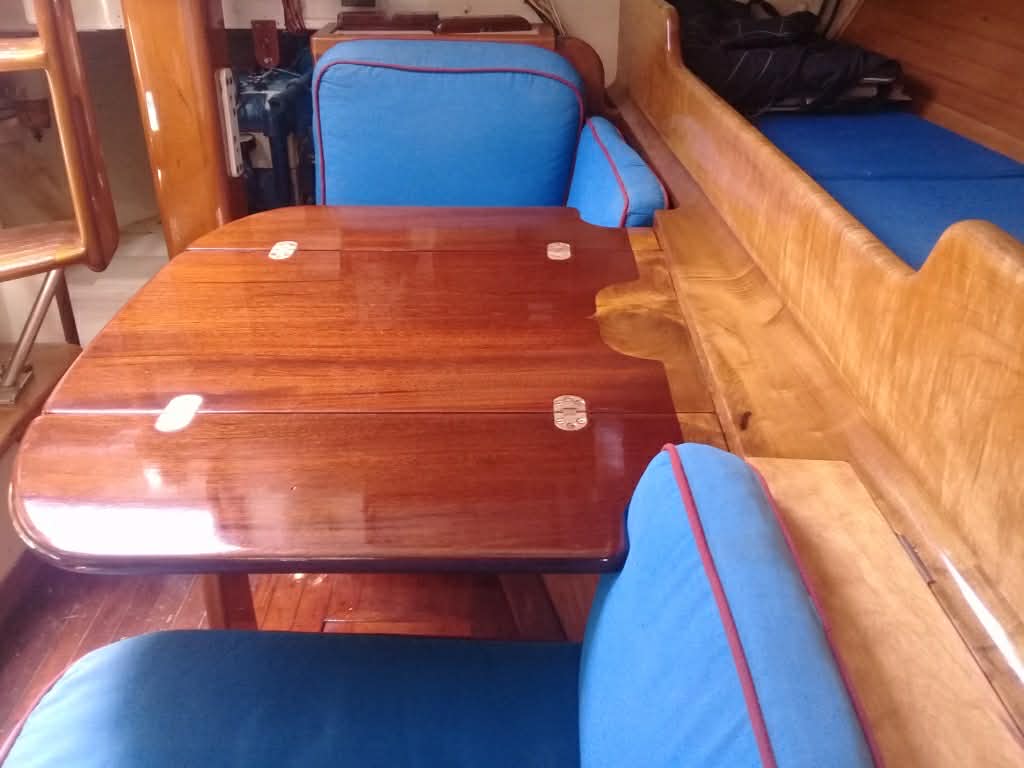
–Dinette: Aft two-person table of African Mahogany (a gift from son, Billy). Table leaves fold for easy access to the Pilot Berth and outboard lockers
–Pilot Berth is 6’6” (198.1 cm) with three deep lockers beneath
–Two 100ah Lithium batteries under berth
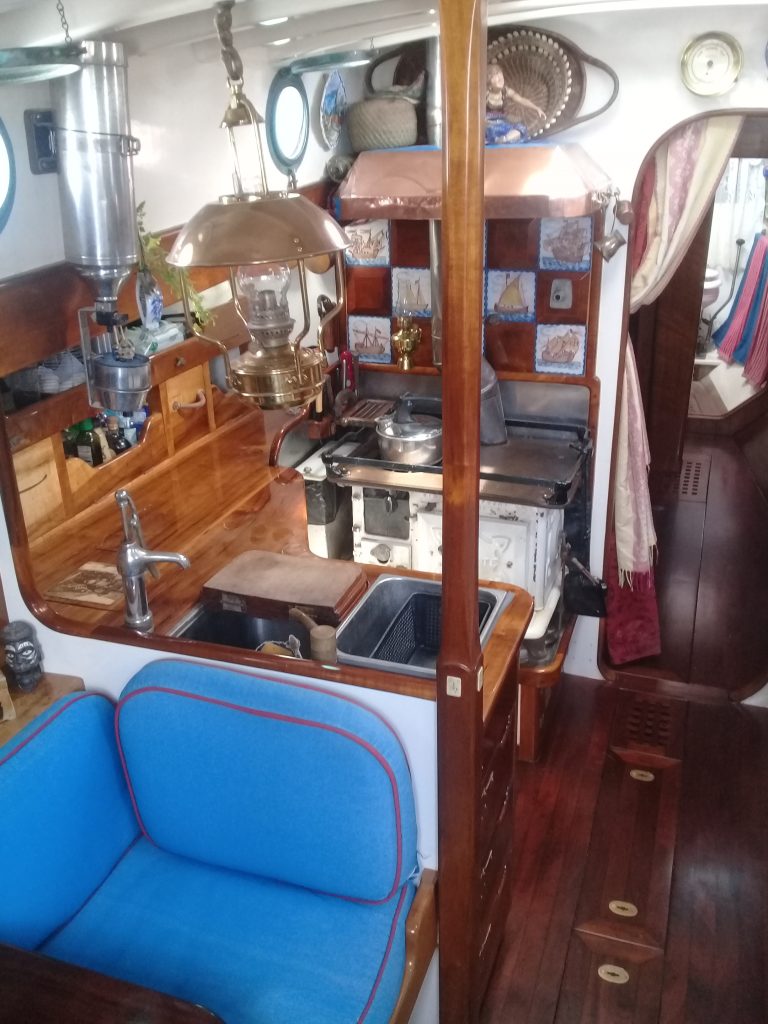
–Galley is midship, U-shaped
–Two stainless sinks
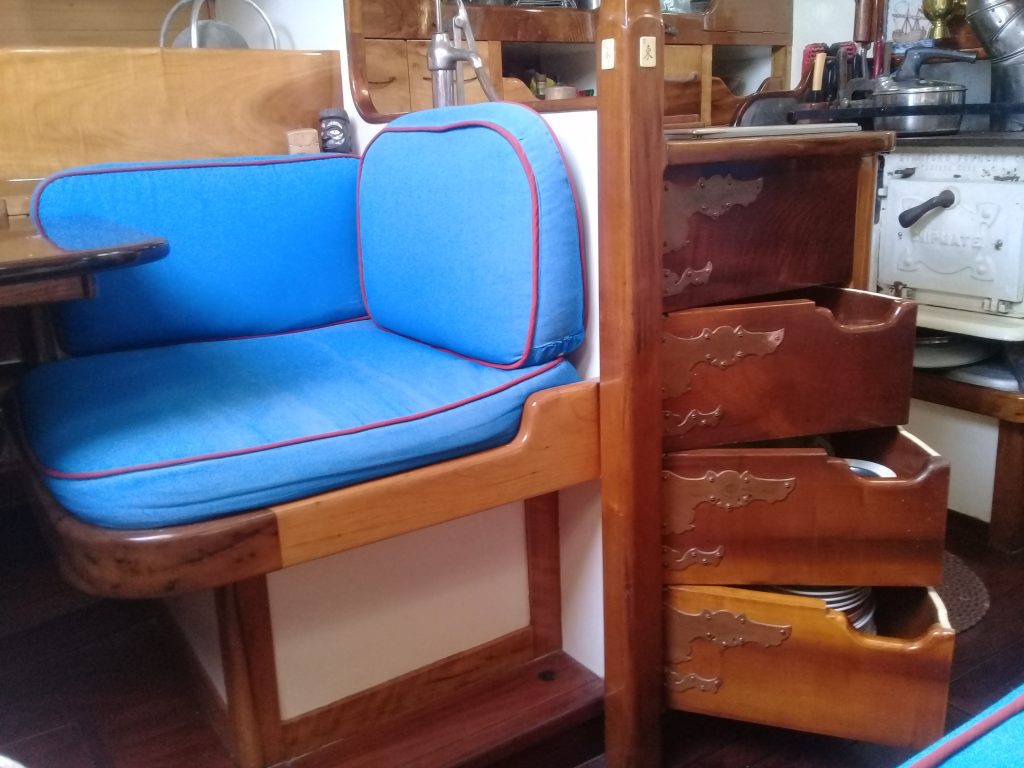
–Beneath the sinks are three swing-out dish drawers on custom copper hinges
–Myrtlewood countertop with five recessed drawers and a removable fiddle
–Positioned athwartship against the major bulkhead , facing the sinks, is PILAR’s cast iron, enameled white SHIPMATE wood cookstove. The bulkhead features hand-painted tiles alternating with dimensional Myrtlewood tiles between stove and copper hood
–Customized, gimbaled SeaSwing kerosene stove for daily use but an especially valued crew member on rough passages
–Forward of the bulkhead is a double bunk 7’1” (215.9 cm) with storage lockers large enough for sails and canning equipmentForehouse & Head:
–Located forward of the sleeping cabin & main mast
–Head is a Wilcox Crittenden SKIPPER II toilet (a true ‘Throne’) on a teak platform
–Burmese Teak floor and grate above shower sump
–Myrtlewood countertop with a vintage white porcelain corner sinkINVENTORY
–Windlass: Moritz, bronze, dual gypsies mounted on White Oak bitts
–Anchors: 60 lb (27.2 kg) Plow; 44 lb (20 kg) Danforth; 41 lb (18.6 kg) Yachtsman; 32 lb (14.5 kg) SS Sea Plane (folding); 100 lb (45.4 kg) Herreshoff Luke 3-piece stock
–Bow Anchor Chain/Rode is 254’ (77.4 m) comprised of 40’ (12.2 m) 3/8” BBB galvanized chain and 214′ (65.227 m) rope.
–Spare chain: 90’ (27.4 m), 60’ (18.3 m), and 28’ (8.5 m)
–Winches: (2) Barlow self-tailing (cockpit); (1) Wilcox Crittenden (cabintop); (2) Barient #10 (main boom)
–Rigging Levers: Vintage bronze running backstay levers (formerly owned by Peggy Slater)
–Bilge Pumps: (2) Rule 500 gph; (1) Gusher Mk II; (1) Edson #217BP-150 (18 gpm), Galley: Whale Gusher Galley Mk III, Custom aluminum-bronze freshwater spigot, Perko High Spout chromed bronze hand pump
–Electrical: (2) 12v Lithium 100ah batteries, Furuno Radar #1623, ICOM IC-735 HF transceiver, MFJ Versa Tuner II 941E, Lucky FF418 Depth Finder; Autohelm ST4000; Solar Panels (60W & 30W), LED interior lighting
–Navigation: Sestrel Major Compass, H. Morin “Hockey Puck”; Saura hand bearing HB65
–Monitor Wind VaneSPARES & MISCELLANEOUS
Yes, PILAR has many spare parts, tools, and repair materials for maintenance as well as necessary “household” equipment that her new owners will need when aboard. Those will of course be included when she changes hands. When that happens, I am going to enjoy imaging the future pleasure PILAR will give them as her numerous unique features are gradually discovered…artful use of vintage items…sculptural solutions to complicated corners…utilitarian fittings of wood or metal…and this small poem:“Love is a journey / the moment it begins / the journey is all it is / no matter where it ends.”
Photos
Video
REMOVING MASTS
RE-STEPPING MASTS
PHILIPPINE (GMA News) YACHTS DOCUMENTARY, Part 1 PILAR & LOCAL LIFE
PHOTOS
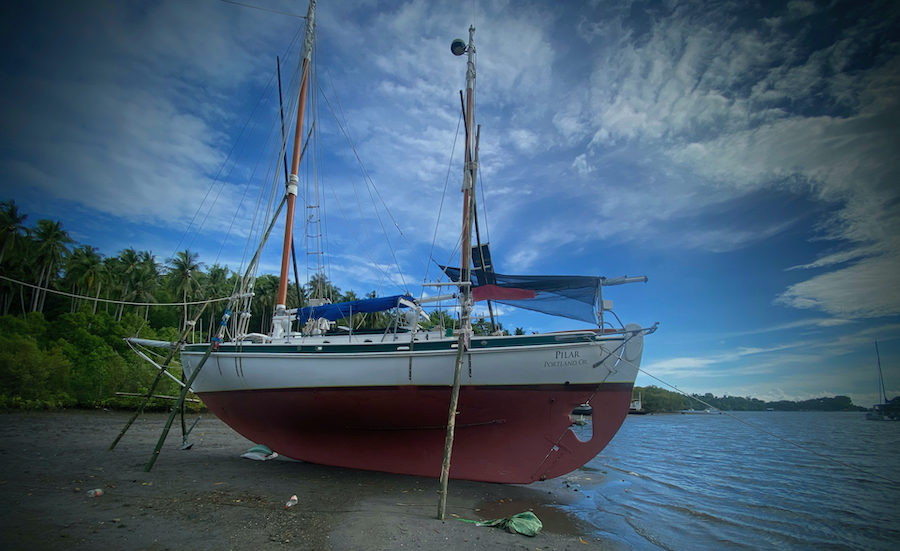
https://www.dianepoolfineart.com/collections/110507BEACH HAUL-OUT
https://www.dianepoolfineart.com/event/128984/beach-hauloutBEACH LAUNCHING
https://www.dianepoolfineart.com/blog/149109/launching-dayPAINTING HULL
https://www.dianepoolfineart.com/event/147826/painting-pilar-portside-hullMap
No Records Found
Sorry, no records were found. Please adjust your search criteria and try again.
Google Map Not Loaded
Sorry, unable to load Google Maps API.
Description
Photos
Video
Map